
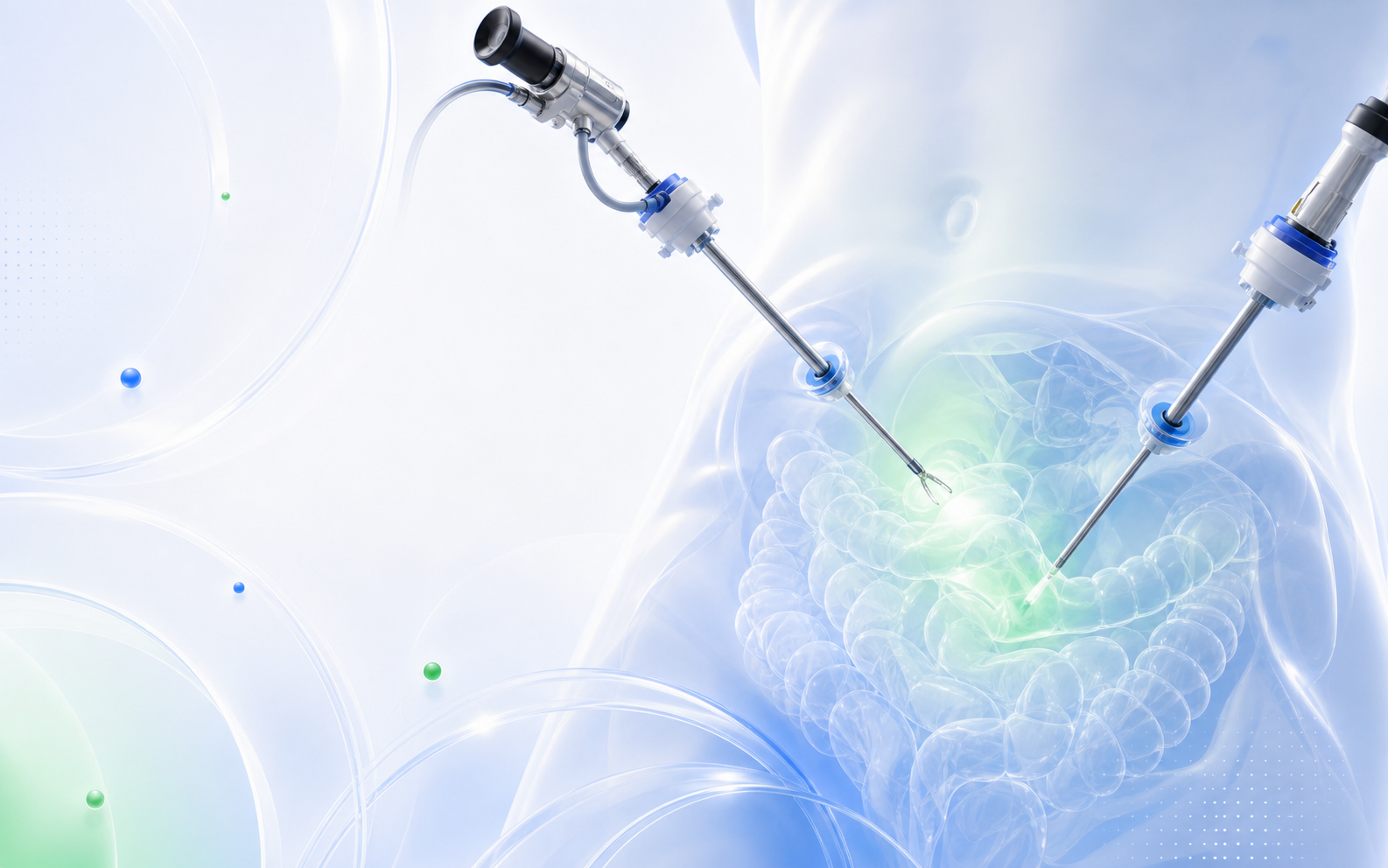
A high-definition camera magnifies the operative field and supports precise instrument movement.
Minimal Access Surgery
Advanced Laparoscopy Care
Camera-guided diagnosis and surgery through small access points, designed to reduce tissue disruption and support earlier mobility.
Small incisions
HD camera guidance
Reduced tissue handling
Earlier mobilisation
Specialist-led surgical care
Duration
45 to 90 mins
Hospital stay
Day care or 1 day
Typical recovery
Procedure dependent
Access
Small keyhole ports
Understanding the Condition
What is laparoscopic surgery?
Laparoscopy uses a thin camera called a laparoscope to view the abdomen or pelvis. The same access points can be used for diagnostic assessment and for operations involving the appendix, gallbladder, hernia, and other abdominal conditions.
Small ports usually replace the longer incision required for traditional open surgery.
Laparoscopy may be used to diagnose a condition, take a biopsy, or complete a planned operation.
Previous surgery, infection, anatomy, and medical history help determine whether laparoscopy is appropriate.
When to Seek Assessment
Symptoms and warning signs
Symptoms can overlap with other conditions. A clinical examination is needed for diagnosis and treatment planning.
Gallbladder disease
Appendicitis
Selected hernias
Unexplained abdominal pain
Pelvic or abdominal assessment
Need for biopsy or minimally invasive surgery
Your Care Pathway
From diagnosis to recovery
Every treatment plan is adjusted to the diagnosis, severity, medical history, and individual recovery needs.
Pre-operative plan
Clinical evaluation, investigations, fasting instructions, and anaesthesia assessment are completed.
Camera-guided procedure
The surgeon operates through small ports while viewing magnified images on a monitor.
Guided recovery
Patients receive mobilisation, diet, pain-control, and wound-care instructions before discharge.
Medical review notice:
This page provides general education and does not replace a consultation. Procedure choice, timing, hospital stay, and recovery vary according to diagnosis and patient health.
Clear Answers
Frequently asked questions
Does laparoscopy always mean same-day discharge?
Some procedures are suitable for day care, while others require observation. The operation and your health determine the stay.
Will there be scars?
Laparoscopy uses small access points, but every incision leaves some scar. Healing and visibility vary by patient.
Can every abdominal operation be laparoscopic?
No. The surgeon may recommend or convert to an open approach when it is safer or technically necessary.
Patient Stories
Patient Experiences at Prime
Feedback from patients who received surgical and diagnostic care under our team.
S
Sandip K.
3 months ago
★★★★★
“I had my laparoscopic appendix surgery under Dr. Pankaj Bhalerao. The entire process was painless and I got discharged within 24 hours. Highly recommended surgeon in Moshi.”
Verified Google Review
P
Priyanka M.
2 months ago
★★★★★
“Extremely professional hospital and polite nursing staff. Dr. Pankaj explained my gallbladder stones issue very clearly and performed a clean keyhole operation. I returned to work in 5 days.”
Verified Google Review
R
Rakesh D.
4 weeks ago
★★★★★
“Best laser treatment for piles. Sutureless and clean procedure. Dr. Bhalerao has an amazing hand. The facility is very clean and billing is fully transparent with TPA support.”
Verified Google Review
Hospital Location
Get Directions
Find Us in Moshi, Pune
Prime Speciality Hospital is located on Dehu-Moshi Road with accessible parking, diagnostics, pharmacy, and surgical care under one roof.
AddressDehu-Moshi Road, Borhadewadi, Moshi, Pune 412105
Consultation HoursMonday to Saturday, 5:00 PM to 9:00 PM
Emergency SupportHospital admission support available 24/7
Book Your Specialist Assessment
Request a consultation for Laparoscopy with our surgical team in Moshi.


